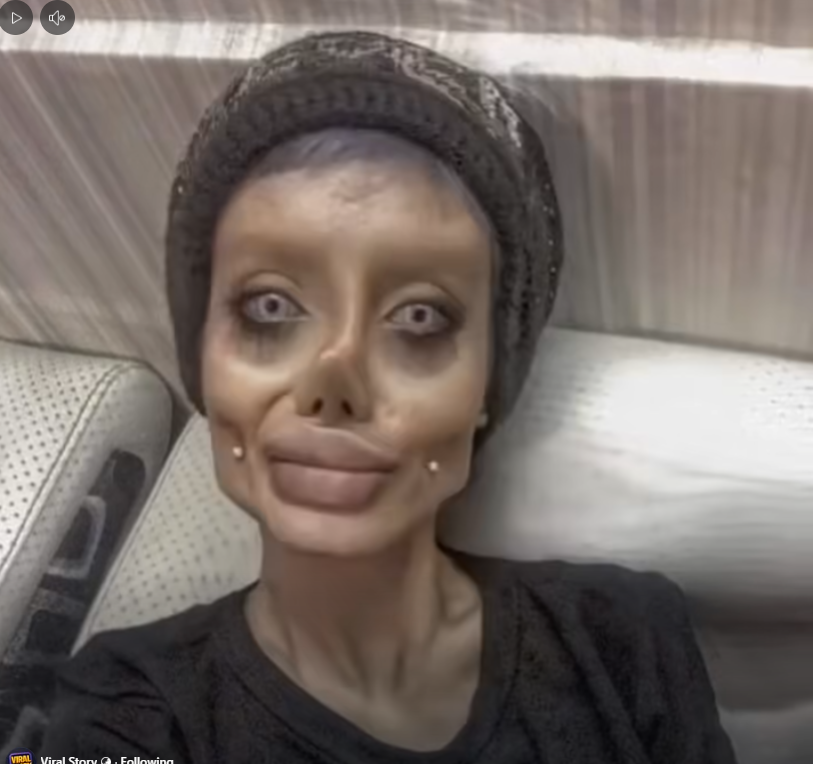
Sahar Tabar, once called the “Zombie Angelina Jolie,” became viral for her eerie selfies. But the truth behind her look — and what happened next — reveals a shocking story about art, fame, and freedom.
💄 The Viral Sensation That Shook the Internet
When Sahar Tabar first appeared online, the world couldn’t look away. Her haunting, doll-like selfies — big eyes, sharp cheekbones, and ghostly skin — spread across Instagram and news sites everywhere.
People were fascinated and confused. Some believed she had undergone dozens of surgeries to look like Angelina Jolie, while others thought it was just clever photo editing.
But the truth was far more complex — and far more human.
🎭 The Truth Behind the “Zombie Angelina Jolie” Look
Sahar Tabar’s real name is Fatemeh Khishvand, a young woman from Iran. She wasn’t trying to copy Angelina Jolie. Using makeup, digital editing, and some light cosmetic procedures, Sahar created a surreal art persona.
She wanted to challenge the idea of beauty — to show how easily social media can twist perception and identity.
“It was not to scare anyone,” Sahar later said. “It was a way to show my ideas and creativity.”
Her photos quickly went viral. Millions followed her. Some called her brave and artistic. Others said she looked “creepy” or “disturbing.” The attention was massive — but also dangerous.
🚨 When Art Turned Into a Crime
In 2019, Sahar’s online fame took a dark turn. Iranian authorities arrested her, accusing her of promoting values against the nation’s cultural rules.
Reports at the time claimed she could face up to ten years in prison. Fans around the world were shocked and outraged.
Ultimately, she spent about 14 months behind bars — a period that completely changed her life.
During that time, Sahar reflected deeply on her art and what it meant to live in a society where creative freedom had strict limits.
💬 Sahar’s Message After Her Release
When Sahar was released, she spoke out to clarify the truth. Her strange appearance, she explained, was mostly makeup and digital effects, not extreme surgery.
Her goal was never to shock or offend — it was to express her creativity and make people think about how easily reality can be manipulated online.
“It was performance art,” she said. “I wanted to show how people can be fooled by what they see.”
Many now see her not as a “zombie version of Angelina Jolie,” but as a symbol of self-expression under pressure — a reminder of how the internet can both elevate and destroy.
⚖️ A Lesson on Fame, Art, and Freedom
Sahar Tabar’s story is more than viral photos — it’s a lesson about the price of online fame and the power of art in restrictive societies.
She showed the world how creativity can cross boundaries, but also how dangerous the internet can be when fame grows faster than understanding.
Today, her name stands as both a warning and an inspiration — a symbol of the blurred line between reality, illusion, and art.
🌟 Final Thoughts
The story of Sahar Tabar reminds us that what we see online isn’t always the truth. Behind every viral image is a real person — with dreams, struggles, and courage to be different.
In a digital world that often rewards shock over substance, Sahar’s journey invites us to think deeper about beauty, identity, and freedom.