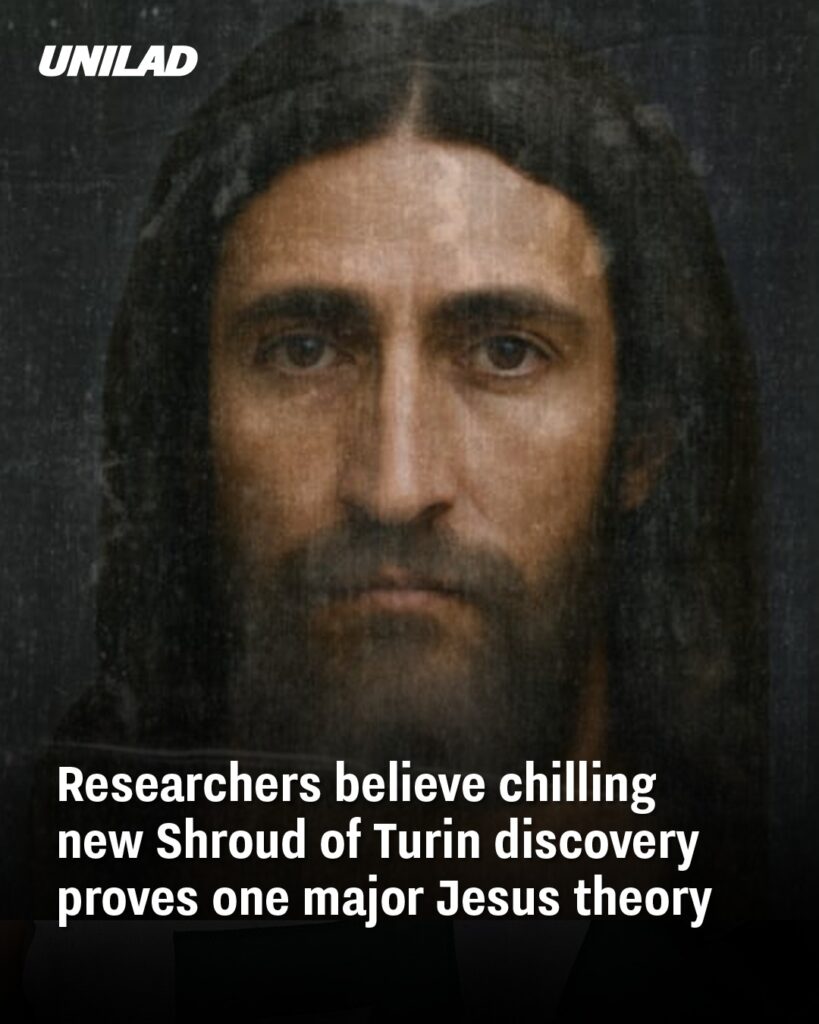
A new study claims the Shroud of Turin reveals evidence supporting the biblical claim that Jesus wore a crown of thorns. The latest research uses AI and image analysis to suggest how the wound patterns match that story.
The Shroud of Turin, a well-known linen cloth bearing the faint image of a crucified man, has long stirred debate about whether it wrapped the body of Jesus Christ after his crucifixion.
A newly-published study by researcher Otangelo Grasso claims to reveal fresh evidence supporting one key biblical theory: that Jesus wore a crown of thorns during his suffering—and that this wound pattern is visible in the Shroud’s markings. UNILAD
What the Research Found
-
Grasso used AI tools and image-enhancement techniques to map the outline and wound patterns visible on the Shroud’s image. UNILAD
-
He focused on the head-area injuries on the cloth, and observed what he describes as vertical rivulets of blood in the forehead and temple region. He argues these match the trauma expected from a “circlet” style crown of thorns, as opposed to a cap-shaped wreath. UNILAD
-
According to his paper, if a heavy dome-style cap had been placed, there would be more “superior-scalp lesions” visible on the vertex. Their absence leads him to favour the circlet (thinner band) theory. UNILAD
Why This Is Significant
-
This research adds a fresh angle to the long-running “authenticity” debate of the Shroud by linking the physical wound-patterns to specific biblical narrative details (i.e., the crown of thorns).
-
For believers of the traditional story of Jesus’s crucifixion, these findings are possible supporting evidence—if one accepts the premise that the image is authentic.
-
It invites wider discussion: even if the Shroud is not Jesus’s burial cloth, the matching wound-patterns provoke questions about whether medieval artists might have intentionally included these details.
What It Doesn’t Do
-
The study does not conclusively prove the Shroud wrapped Jesus. The origin of the cloth remains heavily debated and contested. The Independent+2British Brief+2
-
It doesn’t fully settle the dating issue. Earlier carbon-dating pointed to the 13th-14th centuries. Some newer studies suggest the cloth could be older—but these are still debated. ZENIT – English
-
It may be influenced by interpretation. Mapping AI-derived wounds from an ancient image is subject to assumptions and image-data quality.
Final Thoughts
This new discovery is fascinating for anyone interested in religious artifacts, Christian history, or archaeological mysteries. It shows how modern tools (AI, image analysis) are used to revisit ancient relics.
Whether you’re a believer in the Shroud’s authenticity or a sceptic, the study highlights one thing clearly: the wound-patterns on the Shroud are worthy of deeper attention—and they may connect more closely to biblical narratives than many assumed.
If you like, I can write a longer version for your site with sub-headings, background on the Shroud’s history, expert quotes, and a list of high-CTR keywords (e.g., “Shroud of Turin crown of thorns study”, “new Shroud Jesus evidence”, “AI wound mapping Shroud”) to boost ad performance. Would you like me to do that?