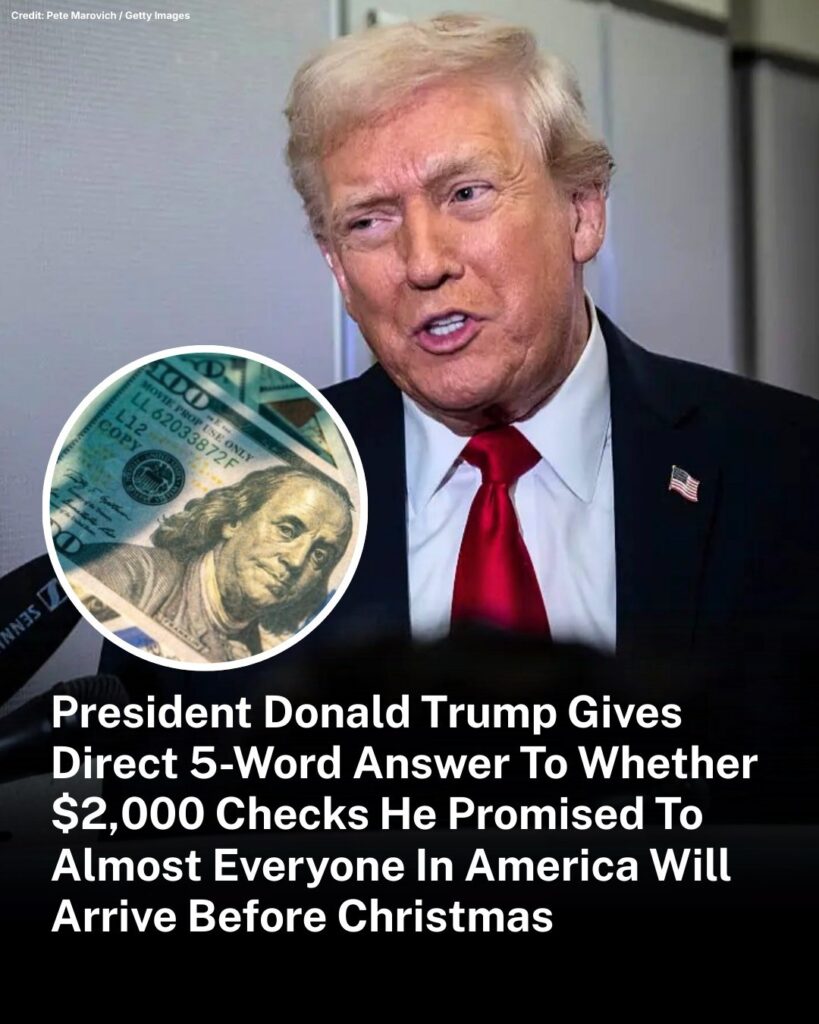
Donald Trump’s new “tariff dividend” proposal promises $2,000 payments for moderate-income Americans, but not until 2026. Here’s how the plan would work, who may qualify, and why economists are divided.
Trump Answers in Five Words About $2,000 Holiday Checks
Former President Donald Trump has once again sparked debate across the country after speaking about his idea for a $2,000 “tariff dividend” payment. The proposal is not a traditional stimulus check. Instead, Trump says it would give Americans a share of the money collected from import tariffs.
The former president explained that he wants to give taxpayers a direct benefit from tariff income without raising the national debt.
In his own words, Trump said:
“We’re talking thousands of dollars.”
However, he made one thing very clear:
No one will get money in 2025.
Payments, if approved, would not arrive until 2026, possibly lining up with the midterm elections.
How Trump’s Tariff Dividend Would Work
Unlike the past stimulus checks that were funded by federal spending, this plan would rely only on tariff revenue.
The idea is simple:
→ The government collects tariff money.
→ A portion would be used to reduce the national debt.
→ Another portion would be paid directly to eligible Americans.
But many economists warn that the math may not add up.
A senior economist from the Tax Foundation, Erica York, explained that if the payout is limited to people earning under $100,000, nearly 150 million adults would qualify. That would cost around $300 billion.
Meanwhile, the U.S. collected only $195 billion in tariffs as of September 2025 — not enough to cover $2,000 for every eligible person.
Some policymakers argue the government could use future tariff revenue, which the Treasury estimates could reach $3 trillion over 10 years, but these projections are uncertain.
Why Economists Are Skeptical
Experts say several issues could complicate the plan:
1. Inflation
Giving millions of people cash may increase consumer spending, raising prices.
2. International Trade Tension
Higher tariffs could trigger retaliation from other countries, which can hurt U.S. exports and raise costs for American shoppers.
3. Financial Risk
If tariff income drops, the government may not have enough money to fund the payments without cutting other programs.
Economists agree that a “self-funded stimulus” sounds good, but real-world conditions make it difficult to guarantee.
Who Might Qualify for the $2,000 Payment?
No official rules exist yet, but analysts expect eligibility to focus on middle- and lower-income households.
Possible income ranges:
-
Lower income: under $55,820
-
Middle income: $55,820–$167,460
-
High income: above $167,460
These numbers could change depending on:
-
household size
-
cost of living
-
number of dependents
Past stimulus checks phased out at $75,000 for individuals and $150,000 for joint filers, so similar limits may apply.
Political Strategy Behind the Proposal
Many analysts believe this idea is both economic and political.
Since payments are expected no earlier than 2026, critics argue the plan could be timed to boost support during the midterm elections.
Public reaction online has been mixed:
✔ Supporters call the idea “a well-deserved bonus” for hardworking Americans.
✘ Critics say it’s unrealistic and could lead to inflation or budget problems.
Even if approved, the payments might be:
-
smaller than $2,000,
-
delayed, or
-
limited to fewer households.
How It Compares to Past Stimulus Checks
Here’s how other programs worked:
2008–2009 Financial Crisis
-
Adults received $300–$600
-
Goal: increase spending
2020 Pandemic Stimulus
-
Americans received between $1,200–$3,600, depending on household size
-
Funded through federal borrowing, not tariffs
Trump’s plan is unique because it tries to use existing tariff revenue rather than increasing debt.
Conclusion: Still Just an Idea
For now, the “tariff dividend” remains a proposal, not a confirmed program.
What we do know:
-
No payments are coming in 2025.
-
Nothing happens without Congress.
-
Tariff revenue must be high enough to fund the checks.
The plan highlights a major challenge in economic policy: balancing taxpayer relief, national debt, trade relationships, and political timing.
Whether the $2,000 checks ever become reality will depend on legislation, budget limits, and the strength of future tariff income.