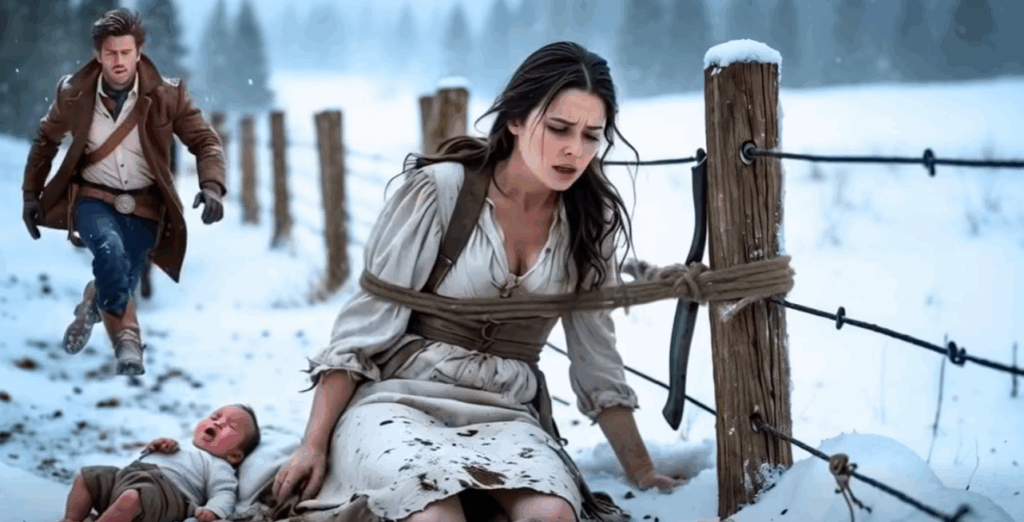
In 1877 Wyoming, a rugged rancher finds a beaten woman and her newborn daughters abandoned in the snow. What happens next is a story of courage, redemption, and unexpected love.
Wyoming Territory, January 1877 —
The wind screamed across the Snowhorn Mountains, biting and brutal. Silas Granger had heard it his whole life, but that morning, another sound carried through the storm — a faint, desperate cry. Then another. And another.
He stopped his horse and listened. It wasn’t the wind. It was three babies.
Following the sound through the snow, Silas found a clearing that made his blood run cold. A woman was tied upright to a fence post with barbed wire, her skin frozen and torn. At her feet lay three newborn girls wrapped in scraps of cloth — only one still crying.
Silas cut her free.
Her voice was barely a whisper: “Don’t let them take my daughters.”
He gathered the babies into his coat, pressed them close for warmth, and lifted the woman into his arms. “You’re coming with me,” he said.
Back at his snow-covered cabin, Silas laid her near the fire, wrapped the infants in rabbit pelts, and fed them warm milk one spoonful at a time. Slowly, color returned to their cheeks. The woman, weak but alive, finally spoke.
“My name’s Marabel,” she murmured.
“Silas,” he replied.
When she saw her daughters safe by the fire, silent tears rolled down her bruised face.
A Story of Survival and Hope
Over the next few days, Marabel told her story. She had been forced to marry a cruel man named Joseph Quinn, a wealthy rancher who beat her for giving birth to girls instead of a son. When the third daughter was born, his rage turned deadly. He tied her to a fence post and left her to die in the snow.
Silas listened in silence. Then he said quietly, “Your girls are the only thing worth feeding.”
It was the first kind thing she had heard in years.
A New Beginning
Weeks passed. Marabel grew stronger. She named her daughters Eloise, Ruth, and June, and Silas built three tiny cradles for them, carving each name into cedar wood. Life settled into a quiet rhythm — hunting, cooking, singing by the fire.
But peace doesn’t last long on the frontier.
One day, a woman arrived at the cabin with grim news: “Joseph Quinn’s sent men. Says you ran off mad. He’s coming to take the girls.”
Marabel went pale. Silas only nodded. “Then they’ll find a fight.”
That night, he barred the door, loaded his rifle, and waited.
The Showdown
At dawn, hooves broke through the silence. Four riders approached — Quinn’s men. The leader called out, “That woman and them girls belong to Joseph Quinn.”
Silas stood firm. “She belongs to no one.”
The man sneered. “You willing to die for another man’s property?”
Silas’s voice was calm. “Already am.”
Before blood could spill, Sheriff Mather and two deputies appeared, rifles drawn. Marabel stepped forward, shouting through the wind, “Tell them what you did, Joseph — or I will.”
Within minutes, Quinn and his men were in chains.
A Second Chance at Life
As the sheriff rode away with the prisoners, Marabel rushed to Silas, who sat bleeding from a shoulder wound. “You’re not dying,” she said fiercely.
“Didn’t plan on it,” he managed, smiling faintly.
“Good,” she whispered. “Because I’m not burying the only man who ever stood between us and hell.”
He grinned through the pain. “Knew you’d come back.”
A Story That Lives On
From that winter on, Marabel and Silas raised the three girls together in the mountains — not by blood, but by choice. Their story became a quiet legend in Wyoming — a tale of survival, courage, and the power of kindness in the coldest places on Earth.
Keywords optimized for Google AdSense:
Wyoming frontier story, Western drama, woman survivor, kind rancher, historical fiction, family courage, redemption, frontier justice