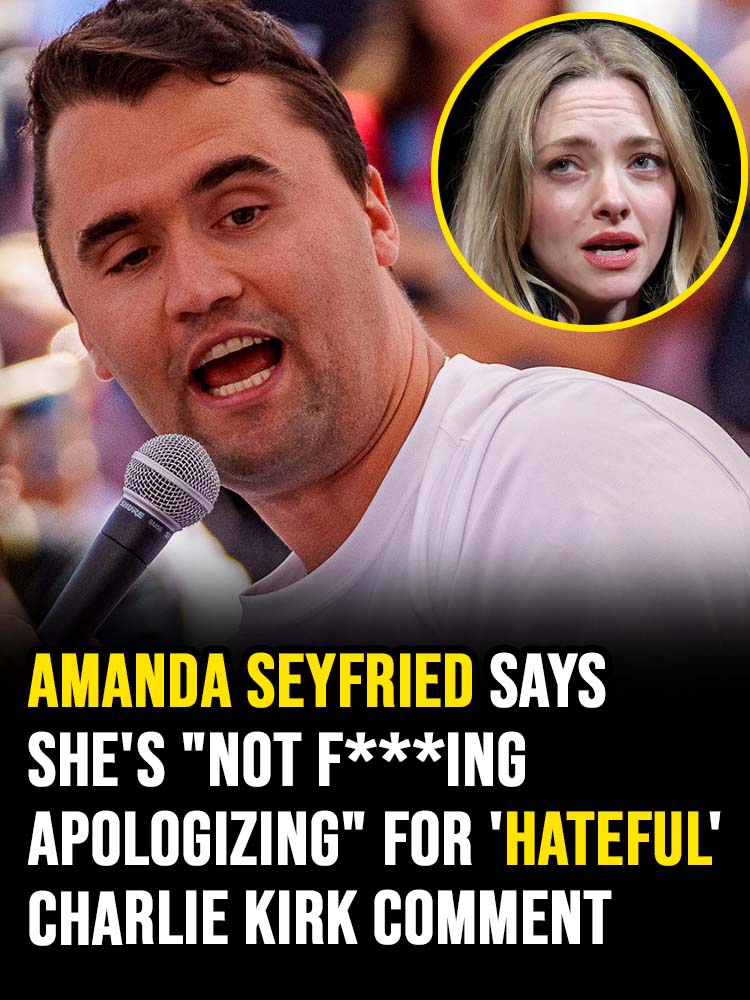
Amanda Seyfried says she will not apologize after calling conservative activist Charlie Kirk “hateful.” Her comments sparked fierce backlash, praise, and a heated debate about free speech and celebrity politics.
Amanda Seyfried is standing firm — and she’s not backing down.
The Hollywood actress recently made headlines after refusing to apologize for calling conservative political activist Charlie Kirk “hateful,” a comment that triggered months of backlash and intense debate online.
What began as a short social media remark quickly turned into a cultural flashpoint, drawing reactions from both critics and supporters across the political spectrum.
The Controversy That Sparked It All
Amanda Seyfried, best known for roles in Mean Girls and Mamma Mia!, came under fire after commenting on a viral social media post that highlighted several controversial statements made by Charlie Kirk, the founder of Turning Point USA.
Her comment was brief but explosive:
“He was hateful.”
Almost immediately, the remark went viral.
Some accused Seyfried of being insensitive and inflammatory, while others praised her for speaking honestly about rhetoric they believe fuels division in American politics.
Backlash, Boycotts, and Online Attacks
Within hours, Seyfried’s comment ignited outrage across social media platforms.
-
Critics called for boycotts of her films
-
Comment sections filled with angry messages
-
Supporters defended her right to express an opinion
The situation quickly escalated beyond a single Instagram comment, becoming a broader debate about free speech, celebrity influence, and political discourse.
Seyfried Clarifies Her Intent
As reactions intensified, Seyfried later shared a longer message clarifying her position.
She explained that criticizing public rhetoric does not mean supporting violence or harm, emphasizing the importance of separating condemnation of ideas from condemnation of people.
Her statement aimed to reintroduce nuance into a conversation many felt had become overly emotional and polarized.
“I’m Not Apologizing” — Her Latest Interview
In a recent interview promoting her upcoming film The Testament of Ann Lee, Seyfried directly addressed the controversy.
When asked if she regretted her comment, her answer was clear:
“I’m not apologizing for that. What I said was based on actual footage, actual quotes, and reality. I’m allowed to have an opinion.”
She stressed that her statement was grounded in publicly available material and was not meant as a personal attack, but as criticism of ideas she finds harmful.
Social Media and Misinterpretation
Seyfried also spoke about how quickly online conversations can spiral out of control.
According to her, short comments are often stripped of context and reshaped by others to fit specific narratives.
She said social media allowed her to reclaim her voice and explain herself directly — something many public figures struggle to do once controversy erupts.
A Deeply Divided Public Response
Public reaction remains sharply divided:
Supporters say:
-
She showed courage
-
She exercised free speech
-
Celebrities should speak out against harmful rhetoric
Critics argue:
-
The timing was inappropriate
-
Her tone fueled division
-
Celebrities should be more careful with influence
The debate reflects broader tensions around cancel culture, political speech, and accountability.
Where Things Stand Now
As of now, Amanda Seyfried has made one thing clear:
She does not regret her words and does not believe she owes an apology.
At the same time, she has repeatedly emphasized that she does not support violence or harm of any kind — a distinction she says has often been ignored in online outrage cycles.
Final Thoughts
Amanda Seyfried’s situation highlights the risks celebrities face when commenting on political figures — especially in a digital age where context can disappear in seconds.
Her refusal to apologize has kept the conversation alive, raising important questions about free speech, responsibility, and how society handles political disagreement.
One thing is certain: the debate isn’t ending anytime soon