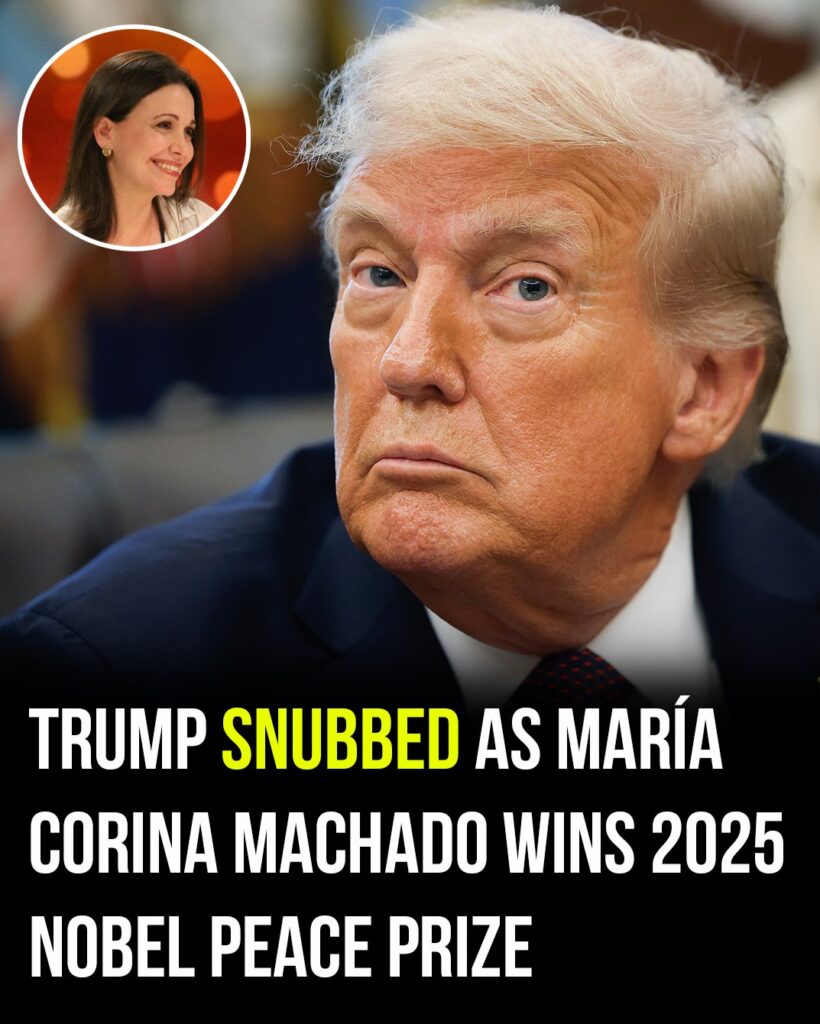
In a stunning decision, the 2025 Nobel Peace Prize went to Venezuelan opposition leader María Corina Machado — not Donald Trump. The choice sends a clear global message about courage, justice, and the true meaning of peace.
The world was stunned when the Norwegian Nobel Committee announced the winner of the 2025 Nobel Peace Prize. Many expected former U.S. President Donald Trump to take the honor after months of speculation and self-promotion.
But instead, the award went to María Corina Machado, a Venezuelan opposition leader who has risked her freedom and life to fight for democracy in her country.
The announcement in Oslo sent shockwaves through global politics. For some, it was a celebration of courage and moral strength. For others, it was a snub to Trump and a rejection of politics driven by ego and power.
🌍 A Global Message About True Peace
Before the announcement, Trump’s supporters had listed his foreign policy achievements — including the Abraham Accords and Middle East diplomacy — as proof that he deserved the award. Betting markets even placed him among the top contenders.
Trump himself appeared confident, telling his supporters at a rally:
“They’ll never give it to me — but everyone knows I deserve it.”
When the moment arrived, however, the Nobel Committee’s decision was clear:
“For her tireless, nonviolent struggle for democracy and her work toward a just and peaceful transition from dictatorship,” the committee said.
The room erupted in applause. The message was unmistakable — this year’s Peace Prize was about courage, not celebrity.
✊ Who Is María Corina Machado?
At 56 years old, María Corina Machado has faced threats, arrests, and political bans under the Nicolás Maduro regime. Despite it all, she continues to call for free elections and human rights in Venezuela.
“This award belongs to all Venezuelans who refuse to give up,” she said from Caracas.
“The world sees us — truth cannot be silenced forever.”
Her words touched millions across Latin America and beyond.
🌐 World Leaders React
Leaders around the world quickly praised the decision.
-
France’s Emmanuel Macron called it a “victory for moral courage.”
-
Germany’s Annalena Baerbock said it was “a tribute to the voice of democracy.”
-
The Vatican described it as “a reminder that peace begins with justice.”
In the United States, reactions were divided. Trump’s campaign released a statement criticizing the committee and defending his record, claiming his diplomacy “saved lives through strength.”
On social media, Trump posted:
“Everyone knows who should have won.”
🕊️ Courage Over Power
Historians noted that while Trump’s administration achieved significant foreign policy moments, the Nobel Peace Prize traditionally honors moral conviction, not political negotiation.
“The committee doesn’t reward power,” explained Dr. Lars Egeland of the University of Oslo.
“It rewards conscience. Machado’s peace comes from sacrifice — not leverage.”
🇻🇪 A Victory for Venezuela’s People
Machado’s win is more than symbolic. It could strengthen Venezuela’s pro-democracy movement and increase international pressure on Maduro’s government.
“This puts Venezuela back at the center of global attention,” said analyst Dr. Rafael Mora.
“It shows that courage can break even the hardest dictatorships.”
Her story is one of quiet defiance — a woman who chose nonviolence over hatred, truth over fear.
⚖️ Two Visions of Peace
The contrast between Trump and Machado could not be clearer.
-
Trump’s version of peace relied on power and recognition.
-
Machado’s peace was built on endurance, humility, and sacrifice.
Even some conservative voices admitted the decision made sense.
“If the Nobel means anything,” wrote commentator Jonah Goldstein,
“It belongs to those who risk something real. Machado risked everything.”
🕯️ A Defining Moment
As the world reflects on the 2025 Nobel Peace Prize, one message stands out:
Peace is not the absence of conflict — it is the presence of justice.
Machado will accept her award in Oslo on December 10, marking both a personal victory and a renewed call for change in Venezuela.
Meanwhile, Trump has already turned back to campaign mode, calling the decision “another example of bias.” But history has a long memory — and it tends to honor conviction over self-praise.
In 2025, two visions of peace stood before the world — one loud, one quiet.
The Nobel Committee made its choice.
And in doing so, it reminded us that real peace is born from courage, not applause.