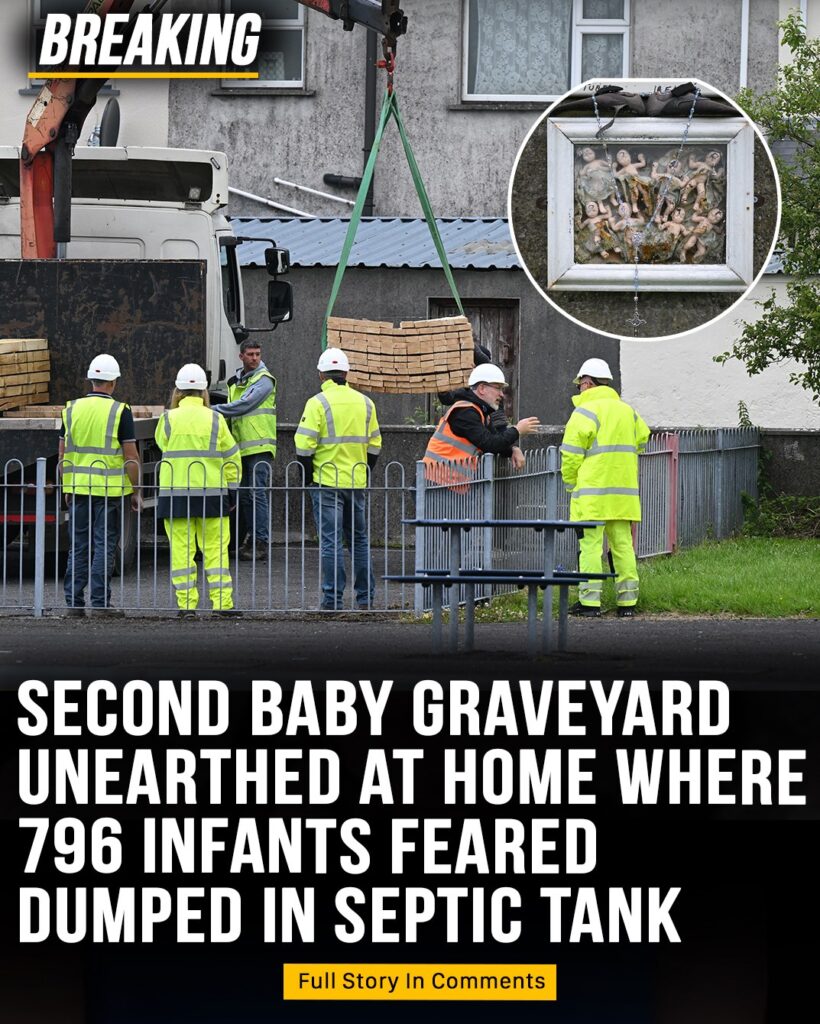
A second infant burial site has been discovered at the former Tuam mother and baby home in Ireland, deepening a national reckoning over nearly 800 babies feared buried there.
A second infant graveyard has been discovered at the site of a former mother and baby home in Tuam, Ireland, intensifying one of the country’s most painful historical revelations.
The finding comes as forensic teams continue excavations to locate and identify the remains of infants and young children who died at the Bon Secours Mother and Baby Home decades ago.
Authorities believe nearly 800 babies and young children who died at the home between 1925 and 1961 were buried on the property, possibly in or near an old septic tank.
Discovery of a Second Burial Site
Investigators working under the Office of the Director of Authorized Intervention in Tuam (ODAIT) recently announced they had uncovered consistent evidence of a second burial area.
This newly identified site lies approximately 55 to 105 yards away from the area previously believed to contain the remains of hundreds of children.
So far, the remains of multiple infants have been recovered, some found in coffins. These remains are now undergoing detailed forensic examination to determine age, cause of death, and potential identification.
At least 160 people have already submitted DNA samples in hopes of identifying lost relatives, reflecting the deep emotional impact of the investigation for families in Ireland and abroad.
What Happened at the Tuam Mother and Baby Home
The Tuam site was one of many mother and baby homes that operated across Ireland throughout much of the 20th century.
Run by the Sisters of Bon Secours, the home housed unmarried pregnant women at a time when social stigma around out-of-wedlock pregnancy was severe.
Many women were isolated from their families, forced to work without pay, and separated from their children. Infant mortality rates in these institutions were shockingly high.
Between 1925 and 1961, official records show that 796 children died at the Tuam home.
The Research That Exposed the Tragedy
Local historian Catherine Corless played a crucial role in uncovering the truth.
She reviewed death certificates for every child who died at the home and compared them with local burial records. Only two burial records could be found.
The absence of burial documentation raised urgent questions about where the children were laid to rest and sparked national and international attention.
The Septic Tank and First Grave Site
For years, local memory pointed to a former sewage or septic tank as a possible burial location.
In the 1970s, children discovered human remains in an underground structure on the site, though the significance was not fully understood at the time.
After Corless published her findings in the early 2010s, government investigations were launched. Preliminary excavations later confirmed the presence of infant remains, validating her claims.
The Ongoing Forensic Excavation
In 2025, a full-scale forensic excavation began under strict scientific and legal oversight.
The process is expected to take several years and aims to recover, analyze, and identify remains using modern forensic and DNA techniques.
The discovery of a second burial area adds urgency and complexity to the work, especially since there were no visible surface signs indicating its existence.
Human Impact and National Reckoning
The Tuam discoveries have deeply affected survivors of mother and baby homes and the families of those who died.
For many, the excavation represents a chance for dignity, recognition, and long-overdue closure.
Catherine Corless has said she feels relief that years of research have finally led to meaningful action and accountability.
A 2021 government report estimated that thousands of children died in mother and baby homes across Ireland between 1922 and 1998.
Apologies and Public Response
The Sisters of Bon Secours have issued public apologies for the suffering experienced by women and children at the Tuam home.
The Irish government has also apologized and introduced redress schemes for survivors, acknowledging the long-term trauma caused by institutional neglect and social stigma.
Many families and advocates, however, continue to call for deeper accountability and remembrance.
Why This Matters Today
The discovery of a second infant graveyard in Tuam is not just a historical finding.
It serves as a powerful reminder of the consequences of silence, stigma, and lack of oversight — and the importance of truth, accountability, and compassion.
As excavation work continues, families hope that identification and memorialization will finally bring peace to those who were denied dignity in life and death.